Why this exists
Film is a better way to take photographs than I am at describing. It is slow,
and the slowness is the point: thirty-six frames on a roll, each one costing
real money, each one meaning something. You commit. You wait. You find out
days later what you actually did.
That intent and purposefulness is what I want. What I do not want is the bill.
What a roll of 36 frames costs, in Europe, today
| Film stock | Develop + scan | A roll | Per frame |
|---|
| Consumer colour negative |
€11 | €13 | €24 | €0.67 |
| Professional colour negative |
€20 | €26 | €46 | €1.28 |
| The same frame, on Latent |
— | — | €0 | €0 |
Film and processing prices as listed by European retailers and labs in 2026:
a 36-exposure roll of Kodak Gold 200 at about €11, Portra 400 at about €20;
develop-and-scan from €13 (Mori Film Lab) to €26 (Studio Baxton), with push
processing around €2 per stop. Latent's marginal cost is zero: the card and
the software are already there, and the camera is one you own.
Filming your way through a year — say fifty rolls — is between €1,200 and
€2,300 of consumables. The same year on a digital camera is a few hundred
frames' worth of disk. That gap is the whole reason film feels the way it does,
and it is why almost nobody shoots it casually.
The obvious answer, and why it wasn't good enough
There are film simulation systems for digital SLRs already. I have tried a few,
and they don't go far enough, for reasons that turn out to be structural rather
than a matter of effort.
-
They treat film as a colour filter. A film is not a grade.
It has grain that grows with exposure, highlights that bleed red through the
emulsion, a characteristic curve, and a speed that decides how much light
reaches it in the first place.
-
They process in the camera, at the moment of capture. That
puts a permanent ceiling on how many films can exist — a camera menu holds a
handful — and it spends the moment you should be thinking about the
photograph on waiting for a processor.
-
They show you the picture afterwards. Which is precisely
what a film camera cannot do, and precisely what changes how you shoot.
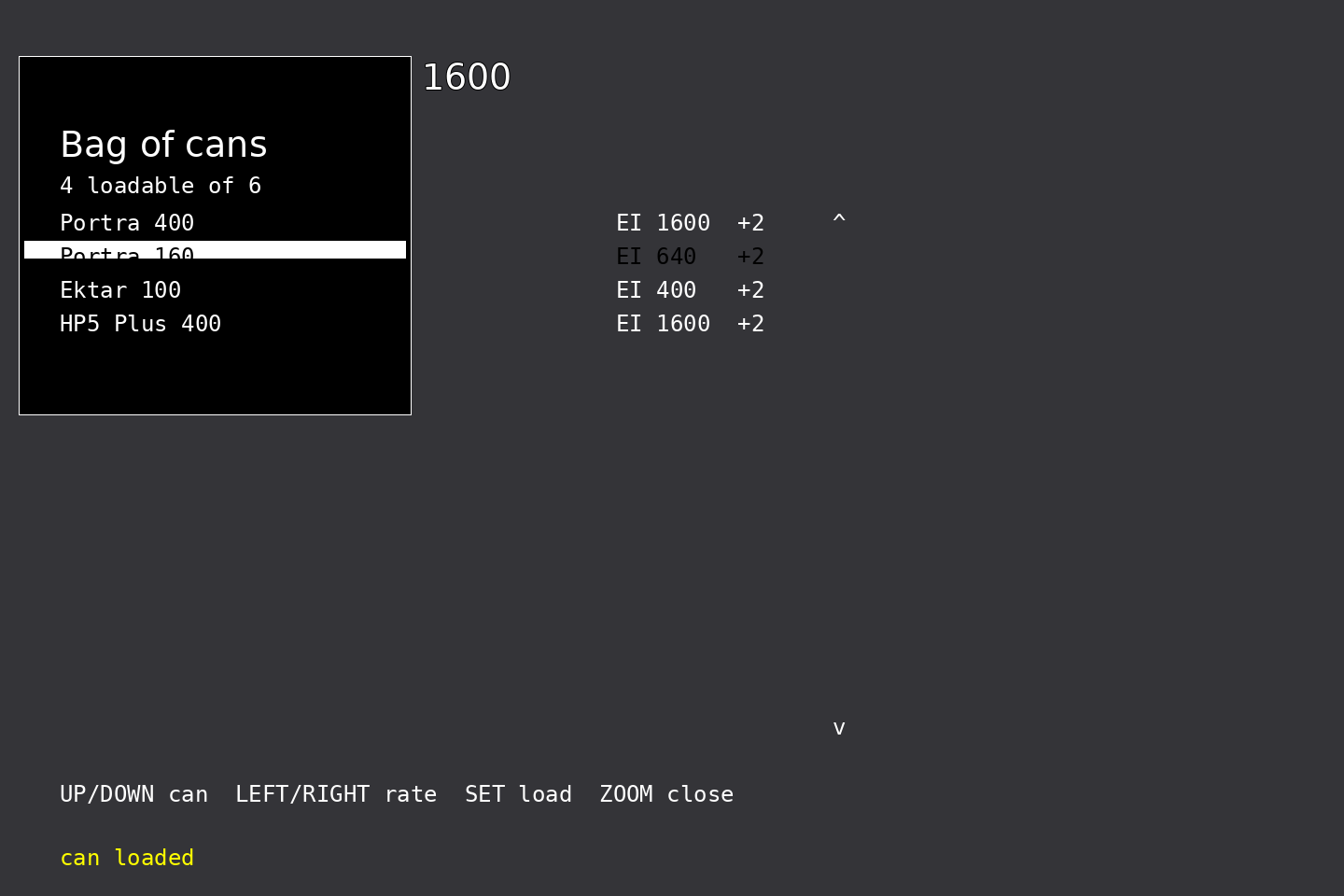
Latent takes the opposite position on all three. The camera does almost
nothing. The computer does everything.